
DoublePredicate Interface is a part of the java.util.function package which is introduced in Java 8. It is an in-built Functional Interface. This function expect one double-valued argument as an input and produces a boolean value as an output. As it is a functional interface, it can be used assignment target for lambda expression or method reference. In this post, we are going to see several implementations of DoublePredicate Interface by using different examples.
DoublePredicate Interface in Java 8 with Examples...!!! Share on X
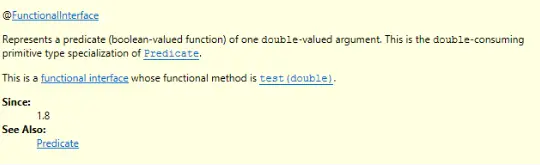
Look at DoublePredicate Javadoc description below:
DoublePredicate Interface contains 4 methods:
test
and
or
negate
Let’s discuss these methods:
test
This method evaluates predicate on the given argument and produces a boolean result.
1 | boolean test(double value); |
and
This method returns a composed predicate that represents a short-circuiting logical AND of this predicate and another. When evaluating the composed predicate, if this predicate is false, then the other predicate is not evaluated.
1 2 3 4 | default DoublePredicate and(DoublePredicate other) { Objects.requireNonNull(other); return (value) -> test(value) && other.test(value); } |
or
This method returns a composed predicate that represents a short-circuiting logical OR of this predicate and another. When evaluating the composed predicate, if this predicate is true}, then the other predicate is not evaluated.
1 2 3 4 | default DoublePredicate or(DoublePredicate other) { Objects.requireNonNull(other); return (value) -> test(value) || other.test(value); } |
negate
This method returns a predicate that represents the logical negation of this predicate.
1 2 3 | default DoublePredicate negate() { return (value) -> !test(value); } |
Lets understand above mentioned methods thorough various examples:
Example 1. ‘test’ method
1 2 3 4 5 6 7 8 9 10 11 12 13 14 15 16 | import java.util.function.DoublePredicate; public class DoublePredicateInterfaceJava8Example1 { public static void main(String[] args) { System.out.println("DoublePredicate Interface - Example 1"); DoublePredicate doublePredicateObj = i -> i == -10; System.out.println("Are numbers matching: " + doublePredicateObj.test(10)); System.out.println("Are numbers matching: " + doublePredicateObj.test(-10)); } } |
Example 2. ‘and’, ‘or’ and ‘negate’ methods
1 2 3 4 5 6 7 8 9 10 11 12 13 14 15 16 17 18 19 20 21 22 23 24 25 | import java.util.function.DoublePredicate; public class DoublePredicateInterfaceJava8Example2 { public static void main(String[] args) { System.out.println("DoublePredicate Interface - Example 2"); DoublePredicate doublePredicateObj1 = i -> i >= 10; DoublePredicate doublePredicateObj2 = i -> i == 5; DoublePredicate doublePredicateObj3 = i -> i < 70; //and operation System.out.println("Result 1: " + doublePredicateObj1.and(doublePredicateObj2).test(15)); //or operation System.out.println("Result 2: " + doublePredicateObj1.or(doublePredicateObj2).or(doublePredicateObj3).test(15)); //negate operation System.out.println("Result 3: " + doublePredicateObj3.negate().test(10)); } } |
DoublePredicate Interface in Java 8 with Examples...!!! Share on X
Do you like this Post? – then check my other helpful posts:
- Passing Function as a Parameter in another Method in Java 8
- Collection sorting using Lambda in Java 8
- Supplier Interface in Java 8 with Examples


